About TELEWORK
Telework, also known as remote work, is a flexible work arrangement that allows employees to perform their job duties outside of traditional office settings, typically from home or other remote locations, using digital tools to facilitate long distance coordination. Telework can range from full-time remote to hybrid work models, where employees alternate between working at the office and remotely, offering a balance of flexibility and in-person collaboration.
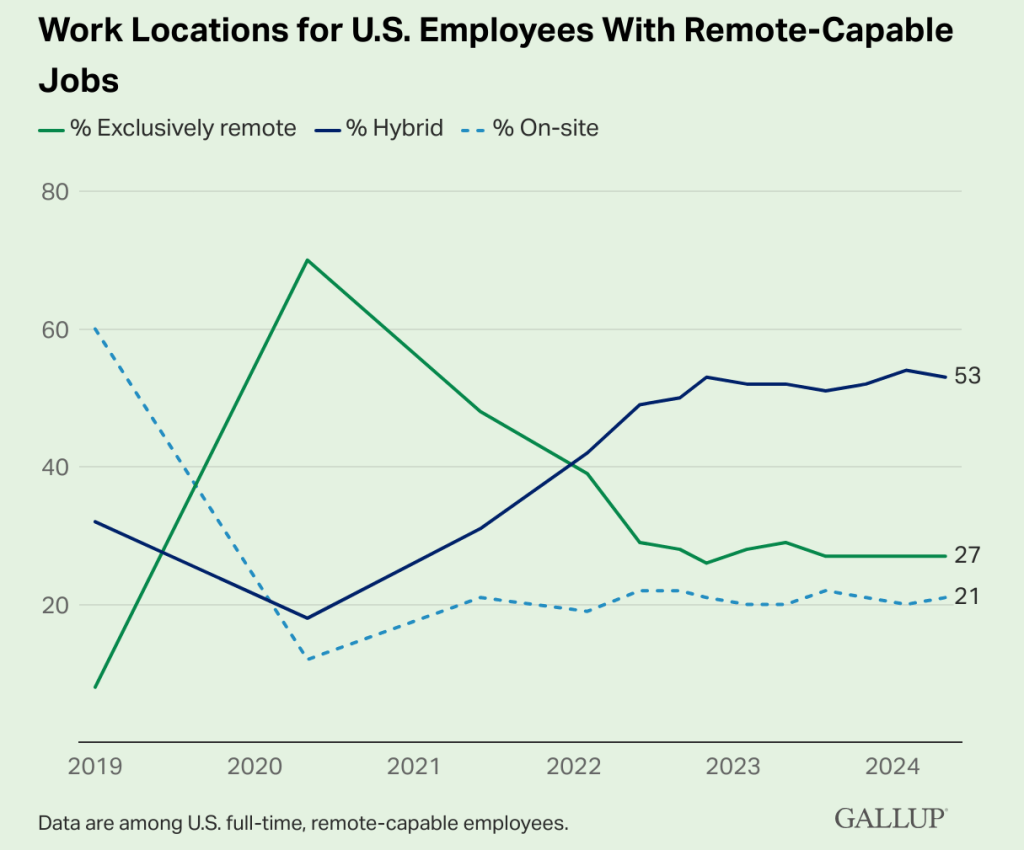
North Carolina is among the top regions in the U.S. for telework. According to data from the 2023 U.S. Census Bureau, Raleigh stood out as the No. 2 city nationwide for remote work, with 24.5% of employees working remotely. Charlotte ranked No. 5 at 21.5%, while Durham secured the No. 9 spot with 19.5%. These statistics highlight the growing trend of remote work in North Carolina, reflecting that the region’s increasing embrace of flexible work arrangements is here to stay long after the pandemic. In 2024, hybrid work has emerged as the most popular form of telework among remote-capable employees, with 53% a mix of on-site and remote work. Hybrid work schedules have eclipsed full-time remote work, which now accounts for 27% of employees. Meanwhile, 21% of employees remain in exclusively on-site roles.

Recently in 2024, Stanford economist Nicholas Bloom and his colleagues published a study in Nature examining the impact of hybrid work schedules on employee performance and organizational outcomes. The research sought to determine whether hybrid work affected productivity, promotion opportunities, and job satisfaction compared to full-time in-office schedules.
They found that hybrid work did not compromise productivity or hinder career advancement, with most employees reporting no change; few reported slightly more (or slightly less) productivity. Additionally, hybrid employees reported higher job satisfaction, and compared to in-office employees, less had resigned by the 2 year mark. These findings provide compelling evidence that hybrid work is an effective model for maintaining productivity while enhancing employee well-being and retention.
Exploring Telework Success: Insights from Real-World Case Studies
-

NIEH’s experience establishing a Telework program
We have an approval process that all employees need to go through before they begin teleworking. This can be an incredibly helpful as it helps us track how many people are interested, how often they plan on teleworking, where they plan on being when they telework, etc. We also have time tracking sheets that help…



 North Carolina Telework